
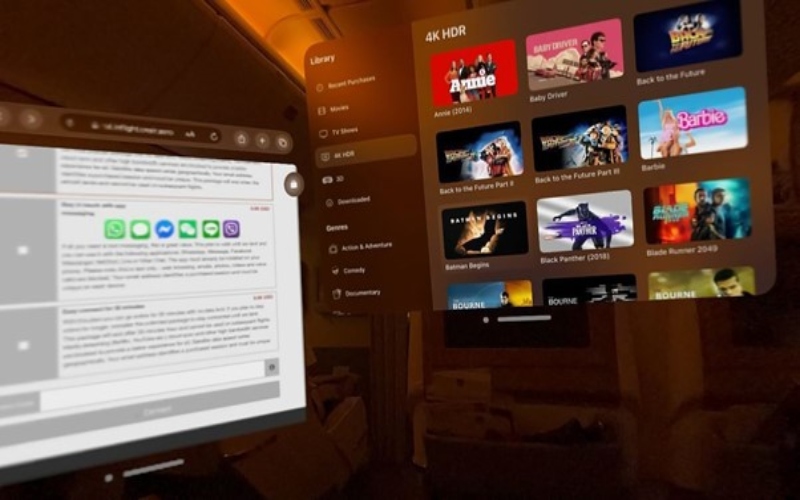
Video screens in business and first class are already pushing the physical boundaries of what airlines can squeeze into these plush suites, but what if you could make the entire cabin into your personal screen?
Less than a week after the global launch of Apple’s Vision Pro ‘spatial computing’ wearable, the high-tech headset has been tested inflight on an Emirates Boeing 777 from Seattle to Dubai.
Instead of watching movies or TV shows on a 23” screen, the entire business class cabin was transformed into a canvas above the clouds.
And the reaction? “This is wild!” exclaimed Omar Shahine, a high-flying Microsoft executive who hooked his new Vision Pro up to Emirates inflight WiFi service on flight EK230.
“I am watching movies and browsing the Web using the entire cabin as my screen,” Shahine shared on social media platform Threads.
However, when it came to audio, Shahine favoured a pair of Apple AirPods earbuds rather than the larger AirPods Max, which he said “would be super hard to use” – presumably given how the chunky Vision Pro strap wraps around the ears.
Asked by a follower about inflight mode, Shahine noted “it’s usable without it.”
Clearly the earliest of early adopters, Shahine also shared some screen captures from an airport lounge at Seattle, where he tried out the Vision Pro prior to his flight with an app to display nearby airports.
First unveiled by Apple in June 2023, the device went on sale on Friday February 2, and the US$3,499 price tag is actually cheaper than a one-way Emirates business class ticket from Seattle to Dubai (around US$4,300).
Apple claims some 200,000 units have already been sold during the pre-order period, with CEO Tim Cook saying the Vision Pro represents a “tentpole moment in technology” similar to other Apple products such as the iMac, iPod, iPhone, iPad and Apple Watch.
The Vision Pro is a triple-play into virtual reality, augmented reality and mixed reality, with Apple describing the headset as a spatial computer which allows users to enjoy content, apps, movies, TV shows, images and videos in their own virtual space.
Users navigate that space with their eyes, hands, and voice: just look at an element, “tap your fingers together to select, and use the virtual keyboard or dictation to type,” Apple explains.
“Apps can fill the space around you, beyond the boundaries of a display. They can be moved anywhere, scaled to the perfect size, react to the lighting in your room, and even cast shadows.”
Qantas briefly – very, very briefly – trialled 3D VR headsets in partnership with Samsung and Tourism NT from January 2015, with a number of Samsung’s Gear VR headsets made available to first class passengers on the Airbus A380 superjumbo as well as in the Sydney and Melbourne first class lounges.
The program ran for three months to “assess customer feedback on how this kind of VR offering might add to their overall travel experience on long-haul flights,” with the aim of opening up “a new world of lounge and inflight entertainment for customers, as well as give Qantas a powerful way to preview destinations and experiences” such as the Northern Territory’s Kakadu National Park.
The VR headsets “will transport customers to an immersive virtual world at the click of a button and showcase the sights and delights of network destinations, new Qantas products and the latest inflight blockbuster movies.”
While this initiative never moved beyond its headline-catching debut, airlines are now embracing the personal technology of travellers, such streaming the audio component of inflight movies and TV shows via Bluetooth to a passenger’s own headset or earbuds… so perhaps it won’t be too long before the plane’s video library will let you take a direct feed to your VR headset?
Source: https://www.executivetraveller.com/news/apple-vision-pro-emirates
