
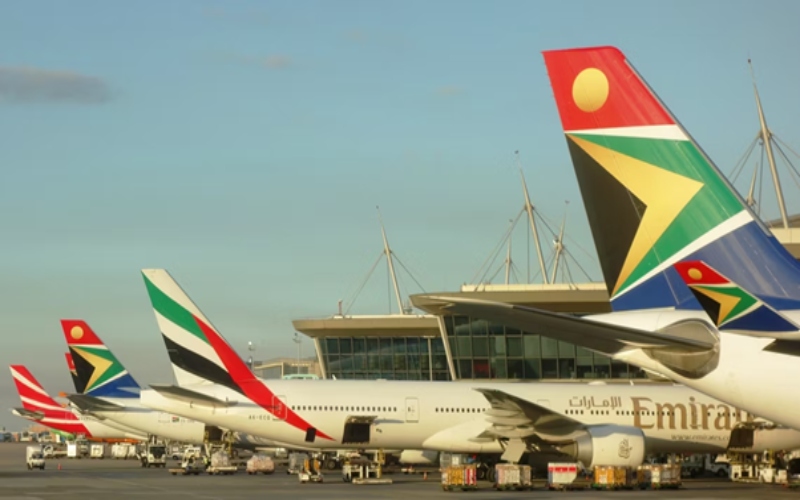
The Airports Company of South Africa (ACSA) has committed up to $1.17 billion (R21.7 billion) to upgrade the country’s airport infrastructure. Speaking at the Board of Airline Representatives South Africa (BARSA) Aviation Summit in Johannesburg last week, South Africa’s Minister of Transport Sindisiwe Chikunga reiterated the details of this significant investment, which is aimed at refurbishing airport infrastructure to enhance asset availability, safety, and the overall passenger experience.
Upgrades at South Africa’s main airports
According to an International Air Transport Association (IATA) report, passenger traffic in Southern Africa is only expected to fully recover to pre-pandemic levels in 2025 or 2026. However, South Africa’s main airports remain among the busiest on the continent and are set to receive significant upgrades as part of ACSA’s long-term project. The $1.17 billion investment is ACSA’s largest capital investment since the preparation for the 2010 FIFA World Cup.
South Africa’s main airport
Johannesburg OR Tambo International Airport (JNB), which handles most of South Africa’s traffic, will receive significant upgrades to its passenger and cargo facilities. ACSA will prioritize the development of a new cargo terminal, known as Mid-field Cargo, at the Johannesburg Airport.
This will be followed by the development of a Mid-field passenger terminal. OR Tambo International will also receive six new bussing gates at Terminal A, while the retail, seating, and lounge areas will also receive uplifts. Additionally, ACSA will add a new mezzanine level to improve passenger circulation and optimize seating capacity.
Cape Town International Airport
The country’s second-busiest airport, Cape Town International (CPT), will see the transformation of its terminals and runway. According to Chikunga, ACSA will prioritize the enhancement of the airport’s domestic arrivals terminal to meet the growing capacity needs. It will expand the meet and greet area, baggage claim area, domestic departures lounge, retail spaces, and ablution facilities. The airport will also receive an additional baggage carousel, three new contact gates, and fixed boarding bridges.
In December, Cape Town Airport broke its all-time record for international traffic in a single month, with over 317,000 passengers passing through its international terminal. As part of the further expansion and development of the airport, ACSA is anticipating the initiation and development of the realigned runway development project. This is expected to increase the airport’s capacity and has been welcomed by domestic operators.
Construction of a hotel in Durban
South Africa’s third-busiest airport, Durban King Shaka International (DUR), will see the construction of a new hotel, considering it is a relatively new airport. However, terminal expansion is expected during the final year of the permission period.
East London’s King Phalo Airport (ELS) will see the expansion of its departure lounge, relocation of the security checkpoint, enhancement of the ablution facilities, as well as the upgrading of retail options in the departure lounge and addition of offices and lounge space on the first floor.
Gqeberha’s Chief Dawid Stuurman International Airport (PLZ) and George Airport (GRJ) are set to undergo terminal expansion over the next two years. Meanwhile, South Africa also seeks to continue investing in new technology and promote the use of remotely piloted aircraft systems. Addressing stakeholders at the BARSA Summit, Minister Chikunga added,
“Distinguished captains of the industry, this is happening in South Africa. As we move forward, we must also embrace the new digital era as it plays a critical role in our everyday living and in saving lives.”
“Our country was among the first in the world to implement unmanned aircraft or remotely piloted aircraft system drone laws and regulations in 2015. This was and is done to ensure safe usage, integration, and innovation of this modern technology into the air transport and aviation space. We cannot afford to ignore the benefits that technology is bringing in our lives.”
The Minister added that an outstanding success regarding implementing remotely piloted aircraft came in August 2022, when the South African National Blood Services (SANBS) was licensed to deliver blood in what became a groundbreaking achievement for the country. Considering that approximately 32% of South Africans live in rural areas with facilities not easily accessible by road, blood delivery will be made easier by using drones.
South Africa also aims to continue moving forward with the use of real-time tracking systems, data analytics, automation, and artificial intelligence to streamline operations, improve visibility, and optimize resource allocation. While embracing innovations and new technology, authorities remain mindful of cybersecurity threats.
Source: https://simpleflying.com/south-africa-1-billion-airport-upgrade-investement/
