
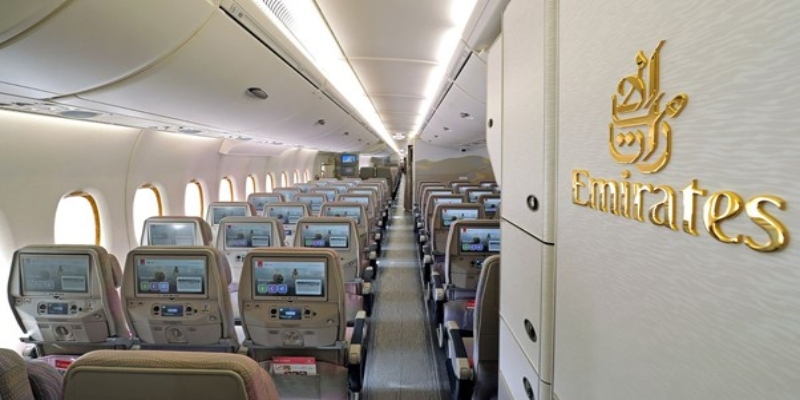
Having launched what is considered one of the world’s best premium economy offerings, Emirates now hopes to reinvent the economy seat.
The airline has already developed a prototype of the new economy seat, which president Sir Tim Clark describes as a “game-changer”, and has been doing the rounds of the seat manufacturers to bring it to life through a co-creation partnership.
But the task is proving to be quite a challenge for the industry veteran, who is credited with building Emirates from a tiny two-plane start-up in 1985 to one of the world’s leading airlines.
“I’ve been pulling the remains of my hair out,” Clark reflects with a smile, in trying to get manufacturers to accept the changes he wants to the new seat’s “pitch and recline.”
Speaking at a media briefing in Melbourne following the Australian Open, which his airline sponsors, Clark also confirmed an all-new Emirates business class suite with sliding doors was on the way.
But when he looked to the back of the plane – which can range from 304 economy seats in the workhorse Boeing 777 to as many as 557 seats in the Airbus A380 superjumbo – “I thought, we’re missing a trick or two.”
Fixing the pain points of economy travel
“We have to deal with all the things that really niggle the economy passengers, and particularly (for) long-haul travel.”
“If you’ve got people sitting in a very tight cabin for 16-17 hours, we’ve got to do better than we’re doing at the moment.”
“The trick is to take modern technology, our learnings in geometry and load, to be able to come up with a seat that will hopefully meet expectations,” Clark explained.
“So we’ve taken the initiative on that… it requires a lot of seat geometry to come into play, and at the moment I’m confident I can get it out through the hangar doors.”
However, a significant hurdle remains in ensuring the seat can pass strict air safety regulations, and “I can’t say whether that’s going to be successful or not.”
Clark suggested aviation regulators “are now really concerned about innovation because of the problems they’ve had” – presumably with the likes of the Boeing 737 MAX and 777X – “so it’s not an easy process.”
Keeping his powder dry
Naturally, Clark wouldn’t be drawn on those claimed innovations for improving pitch and recline.
“I’m not saying how we’re going to do it,” he laughed.
However, he described the notion of a pre-recline, where the seat is initially reclined by several degrees as a starting point, as “difficult.”
Clark says Emirates effectively “redesigned” long-range economy seats some two decades ago, both for passenger comfort and to make the seats lighter so the aircraft would burn less fuel.
“These seats used to weigh about 29-30kg with the IFE system, we got that down to 13kg,” Clark said, citing better design techniques and “metallurgical improvements” which influenced the seat’s physical construction, along with ergonomic tweaks to the seat cushion and back.
Clark believes that Emirates’ re-engineered economy seat “became the benchmark” for other airlines, “but since then, nothing has really changed.”
Source: https://www.executivetraveller.com/news/emirates-new-economy-seat
